


©Fede Caraduje
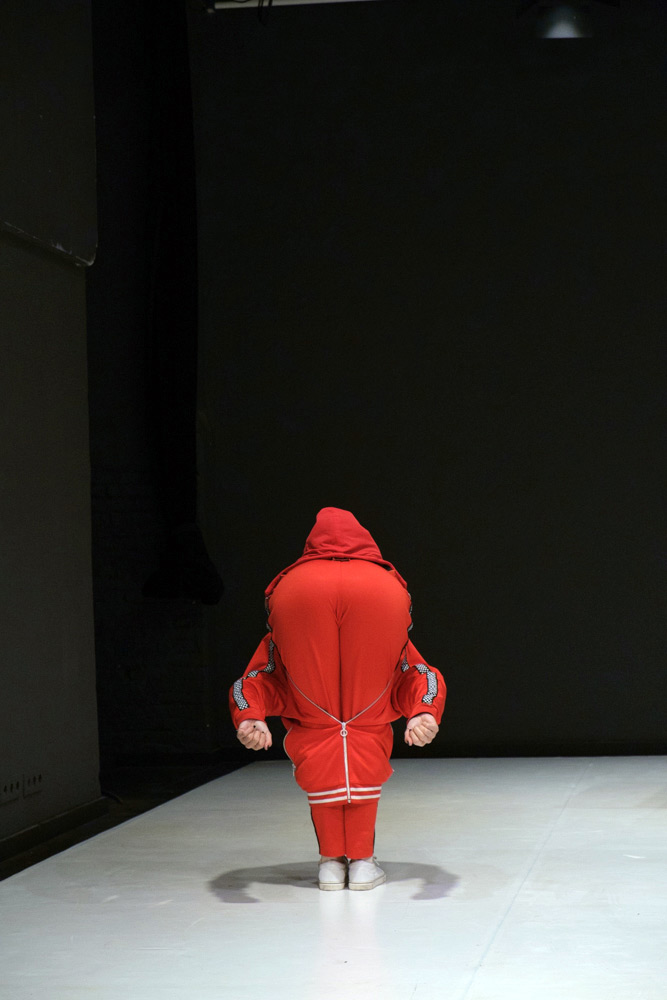
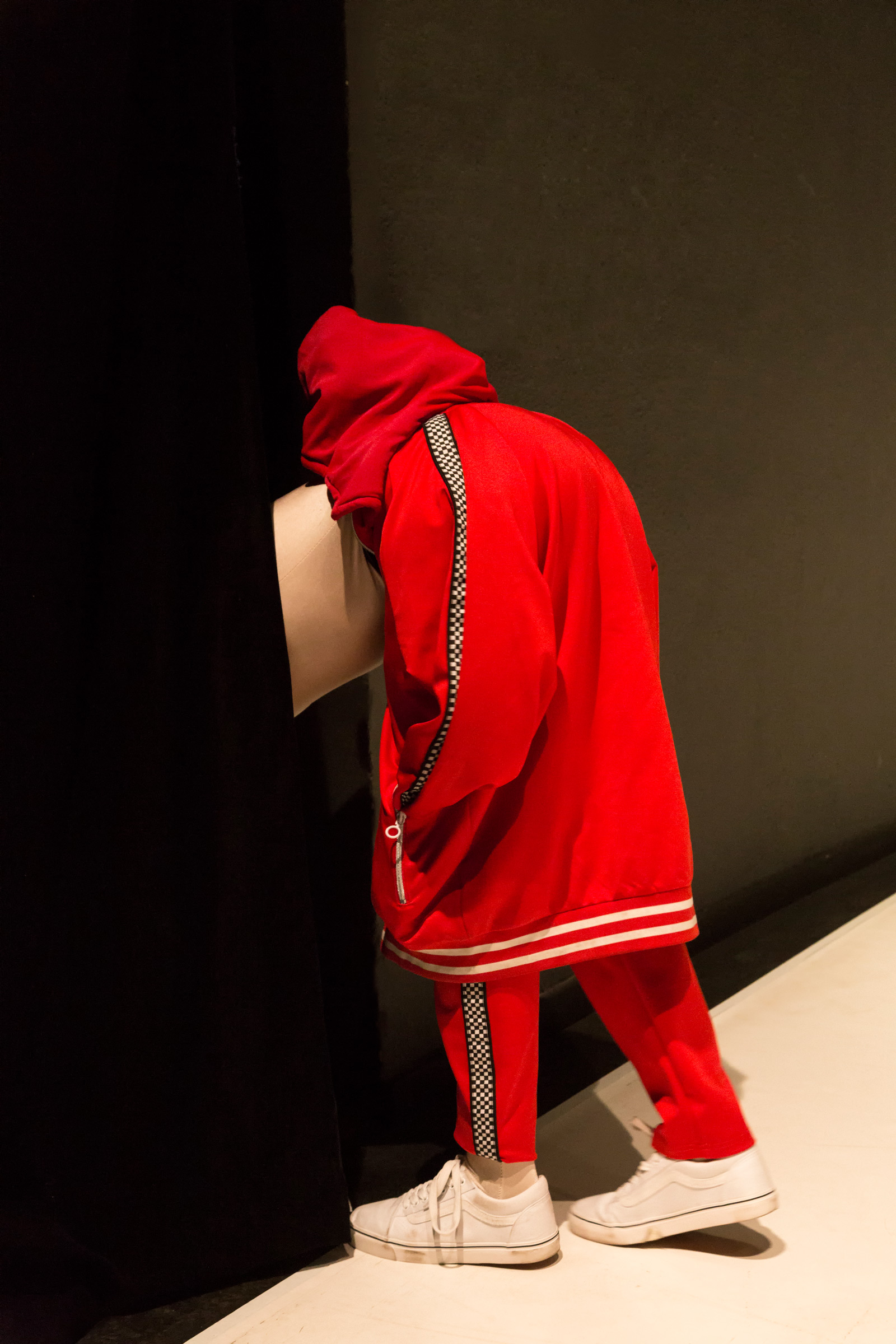
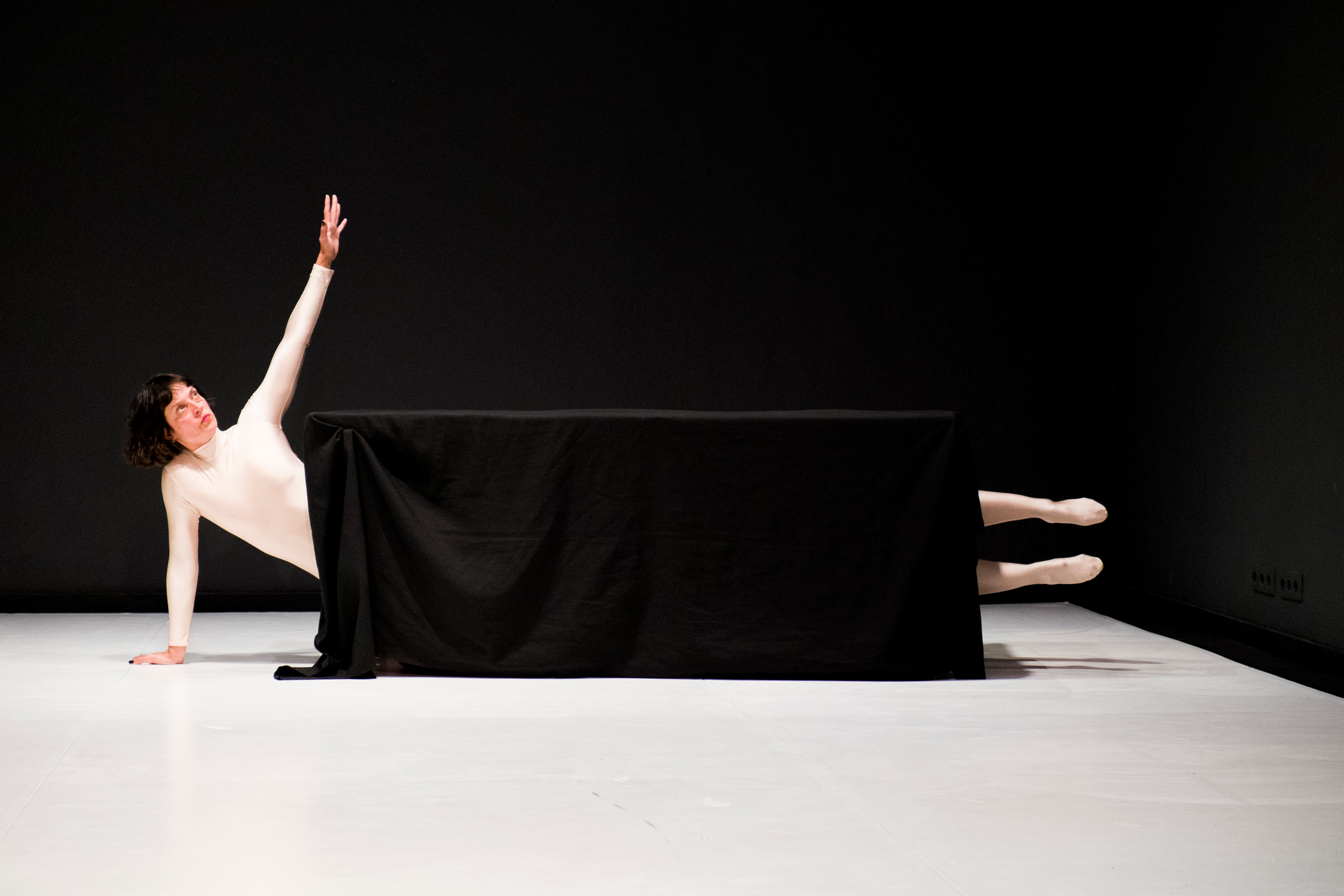
If It Were a Movie is a piece that explores the possibilities of sound in cinema to rethink the theatrical scene. A sound that dramatizes, fictionalizes or re-signifies the images it touches, producing strangeness, humor, or becoming a metaphor traveling from the plausible to the unreal. This overlapping of narrative elements, sound linked to the cinematographic and the scene, shows us the potentialities of both. Sound as a generator of unlimited possibilities and the scene with its infinite code of representation.
Fira de Titelles de Lleida 2026 Award – “Most Innovative Performance”
Piece selected in the SAREA 2026- 2027 Catalogue
Concept: Macarena Recuerda
Performers: George Marinov and Macarena Recuerda
with the collaboration of Idurre Arriola and Irantzu Azpeitia
Sound production: Alberto de la Hoz
Lighting: George Marinov
Light audiovisual: Macarena Recuerda
Choreographic advice and costume: Jorge Dutor
Music: La Bravo & Gydeon.
With the collaboration of Segundo Olaeta Musika Eskola (Gernika-Lumo): Artur Sustatxa (Arrangements), Unax Atristain (Trumpet), Beñat Zobaran (Trumpet), Gartzen Cosme (French horn), Iñigo Jaio (French horn), Gartzen Cosme (French horn), Ekaitz Gutiérrez (Tuba) and Martxel Asteinza (Percussion)
A production by Macarena Recuerda Shepherd, Antic Teatre with the collaboration of the Basque Government.
Residencies at Gernikako Udala, El Graner (BCN), Aulestiko Udala, Zornotzako Udala, Bilboko Udala, Teatro Ensalle (Vigo) and La Mutant (Valencia).


©Fede Caraduje



©Jordi Valdivieso
Reviews
“If it were” by Stanislavski, through the Macarena Recuerda Shepherd method
By Afonso Becerra
12/05/2025
Macarena’s performances always exceed expectations. Everything I’ve seen surprises me every time. She manages to fascinate while researching and exploring the boundaries of dance, theatre, and movement arts. I believe her works always carry a certain metatheatrical dimension—a practical reflection on artistic methods, forms, and discourses.
In this case, the performance is a sonic mimesis of a cinematic story, imagined from the live sound actions performed before us. A curious postdramatic proposal that uses the concept of imitation/representation/mimesis—rooted in the Aristotelian dramatic tradition—applied here to the imitation or representation of sound scenes (without words).
At the same time, it brings to mind Peter Brook’s theory of The Empty Space, which suggests that neutral objects, through action, can stimulate our imagination to recreate scenes—for example, a stick becomes an imaginary horse or sword. In this sense, we might say this is The Silent Space of Macarena Recuerda, stimulating our imagination through a performance that activates various objects to produce sounds, allowing us to reconstruct dramatic scenes: a walk in the forest, entering a cave or mysterious place, a dangerous chase, a fight, and other adventures—as in an action film.
Furthermore, If It Were a Movie also leads us to Stanislavski’s magical “if,” to the subjunctive dramatic situations of “what if,” in that split between who we are and where we are, and the exercise of imagining extraordinary or fictional scenarios.
If it were a movie, it would be one we project in our imagination, emerging from the sound universe created before our eyes. Here, the stage device and the scenography, as an artistic laboratory, function in a hands-on, crafted dimension that delights and focuses us on all those activities through which Macarena and George Marinov audibly recreate/represent scenes from a hypothetical film. This contrasts with the imagined fiction, creating a tension between the materiality and physicality of the stage action and the fantasy projected on the screen of our imagination. It is undoubtedly a fascinating exercise in which the sensory is heightened and proves its eloquence.
It is a playful way of awakening our dormant senses in an era where AI (Artificial Intelligence) and the digital world seem to atrophy them, offering to solve everything for us and replacing our own creativity.
A special mention goes to the opening, with everyone wearing headphones, listening in whispers to a conversation between two spectators speculating about what they’re about to see. The kind of talk where no one really understands these “avant-garde” proposals, but maybe it’ll at least be fun or entertaining—and anyway, since most people have little to say about them, there’s always the comfort that it probably won’t last long, because contemporary theatre people aren’t known for being very hard-working… (a paraphrase from what we heard at the beginning). A blessed moment of humour and irony, serving as a kind of comic captatio benevolentiae, a murmur that perfectly summarizes the “burden” often placed on postdramatic theatricalities, or what we also call contemporary creation.
Macarena Recuerda Shepherd presents If It Were a Movie at La Mutant on May 23 and 24.
In the press release for COSA. Intervening a Body, presented at Teatro Ensalle (Vigo) from October 18 to 20, 2024, we find the following:
In 2017, Macarena Recuerda Shepherd began creating the Illusionism Trilogy. It is the staged manifestation of research that led her to explore how illusion connects with the essence of theatre—exposing convention and magic, reality and its double, action and fiction on stage. These are pieces that creatively, playfully, aesthetically, and provocatively challenge our perception of reality. They do so with no hidden tricks—or rather, with “the trick in plain sight,” shaping works in which our brain inevitably falls into the trap, whether we give permission or not. A (un)conscious ode to imagination over certainty.
In COSA, performers become a kind of “animantras” who “lend their bodies” to literally bring to life the objects they encounter on stage.
What follows this trilogy is a very different game (as are the three previous pieces among themselves) but continues to explore and exploit Macarena Recuerda’s capacity to displace the audience—both literally and figuratively. I think, for example, of the use of the “fourth wall?” in this piece, and I can’t help but laugh. Macarena and George Marinov suggest that the real performance takes place in an imagined space above our heads. I could clearly see the tape running (at Ensalle, along a beam above the stage), but then—where am I?
George and Macarena’s hyper-focused attention is fixed throughout the first part on a hypothetical place, a sort of cloud floating above our heads. The sequence of images in that cloud captures the creators in total anticipation, making me disappear entirely from my seat. That often happens with Macarena. I enjoy pieces that unsettle—and she tends rather to “dis-settle” me. Are the performers’ gazes more present than mine? Does this piece take place more in that damned beam than on stage? What am I doing here? Am I really watching the sound studio of an animated film where the actors, whether unconsciously or willfully, ignore our presence (laugh again at the fourth wall)?
Yes, Artús, that seems to be the proposal—it’s a theatre piece calling itself If It Were (or Was) a Movie; they haven’t decided yet, but it’s clearer in English. The moment I sit down, someone in the audience whispers, “with a title like that, it’s off to a bad start,” or something like that—I can’t be sure, I’ve got my headphones on. The headphones, by the way, are like a thin wall separating me from the rest of the audience to immerse me in the piece, isolating me while merging me exceptionally with the rest of us innocents ready to enjoy like kids.
Something must be said about Macarena’s technique. The piece demands enormous technical precision in handling light and sound, combined with a performance that’s as “intense” as required for a good dubbing—and let’s not forget the sustained attention on that damn beam. Her discipline is evident: years of training, broad and multidisciplinary experience, an impressive CV with respected companies… But here, Macarena uses that experience like any other object or tool on stage. Her experience becomes just another element, application, or toy. Because they take the game very seriously—what else could it be?
Without intending to give spoilers (what we used to call “a real jerk”), I’ll go over the memory of this latest invention Macarena Recuerda left me with:
Displaced in my seat, unsettled in my chair, I’m ready for Macarena and George to play tricks on me—I’m all ears so I don’t miss a beat. Some ESAD Vigo students are here, likely sent by a professor with a sense of humour. I don’t envy their youth so much as their unawareness of the company, when they fall for the first trap. I’m not worried—my neocortex will gladly pay the price for what’s to come.
We begin with a kind of warm-up for creators and audience—a prelude foreshadowing the proposal. As stated in the press release, they show us the trick and the trap. This is not a magic show. If anything, it’s the opposite of a show. As for the magic, dear companions in the audience, that depends on each of us.
Then the film begins—Macarena Recuerda’s cinexin. Just like the company, I press play on the reel in my head. I must mention the onstage harmony between the performers—it invites us into a state of openness, where sound produces vivid images that fully place you inside the reel happening in the very space you occupy (in fact, you’re part of the projection).
I remember one moment that shows how immersed I was: the sound of a nocturnal bird in broad daylight created a delightful sense of strangeness. That’s how the first part unfolds in my memory—until some “displacements,” let’s call them, bring a curious paradox, mixing fictionalized reality with the real fiction happening onstage. It’s like a hall-of-mirrors game that immerses you in its/your own fiction—one that appropriates the show itself. It reminds me a bit—though I may not explain it well—of The Neverending Story, or Sophie’s World, or better yet, Zhuangzi’s paradox, which shares the same curious restlessness Macarena Recuerda conveys.
That brings me to a critical (perhaps political?) nuance I find—maybe by my own tendency—in this company’s work. It echoes Borges’ interpretation of the Chinese master’s paradox. I’ve saved it for the end because it fits best here, but also because I wanted to first describe the second part of the piece, or rather, the essential epilogue.
A fog closes the first part and envelops us, ushering in the second act. Here the sound is “pre-recorded,” and now light becomes the protagonist. Remember—we’re in the projection. A projection that cuts through the mist to cover the audience.
As I write, I realize the central theme for me is space—that constant question: “Where the hell am I? Where is my attention? Where is the piece? Where is what’s happening?”
Images are projected on the surface of my face. Normally, images reach my eyes via light reflecting off matter, then travel down a channel to my brain to be processed. But in this new play of reflections, that part of my brain becomes a black box where the film is projected. The image appears inside my brain. My skull is the cinema. What I see is merely light and color—in other words, undecoded image. So… is the brain the projector?
I know this sounds delirious, paranoid, overthought—disconcerting and fun. Disconcerting like everything fun; fun like everything disconcerting. The blame for this delightful confusion lies with George Marinov, a man with such a taste for lighting that you’ll be hearing more about him—believe me.
This is the journey of the second part, ending the piece (sorry—the movie) with, of course… (SPOILER ALERT!!) the end credits.
It’s the talk of the town, as they used to say—reality is constantly being created, it’s a work in progress. And as they’d also say where I’m from, Macarena, though playful, has a rebellious streak. She’s a saboteur.
Here is the reflection I promised, in which I feel Zhuang Zhou allegorically presents the work of Macarena Recuerda and George Marinov—and Borges, finally, helps me understand (thank you, JL) where I was:
Long ago, I, Zhuang Zhou, dreamt I was a butterfly—fluttering happily, free, unaware I was Zhou. Suddenly I awoke, and I was indeed Zhou. But I wondered: was I Zhou who had dreamt he was a butterfly, or a butterfly dreaming I was Zhou? Surely there must be a difference between Zhou and the butterfly. This is what I call “the transformation of things.”
Zhuangzi, Qi wu lun (The Discussion of Things)
In China, the dream of Chuang Tzu (Zhuangzi) is proverbial. Imagine that one of his almost infinite readers dreams he is a butterfly, and then that he is Chuang Tzu. Imagine, by a not impossible chance, that this dream exactly repeats the one the master dreamt. If that identity is accepted, we must ask: those identical instants—are they not the same? Is one repeated term not enough to disrupt and confuse the history of the world, to suggest there is no such history?
J.L. Borges (1899–1986), A New Refutation of Time, in Other Inquisitions (1952)
Artús Rei
In this piece centred on sound effects for cinema and radio, co-produced by L’Antic Teatre, a dizzying inversion of values takes place and what is peripheral becomes central.
Lidia González Zoilo was the dark-haired third of Amaranto, a physical theatre trio that set out to make its artistic mark in the early 2000s. A reflection of their struggle was Four Movements Not to Drop Dead, an ironic show in which they beat each other up quite fiercely. After the group dissolved, as if by sleight of hand, someone called Macarena Recuerda Shepherd appeared on the alternative stage scene. Through this heteronym, González Zoilo entered the marvellous world of illusionism.
¡Ay! ¡Ya!, a piece she produced in 2018, is a succession of astonishing human trompe-l’œil effects that she and the dancer Sofía Asencio, her blonde alter ego, weave and unweave with their anatomies. In that joyful universe, a female bottom becomes the face of an elf; the black-painted fingernails of the index and ring fingers become a hobbit’s pupils; and Lidia’s long hair turns into a priest’s beard. At times Sofía loses her legs and borrows her colleague’s, who in exchange takes her arms. But what they lose most often is their heads, like French aristocrats during the Terror. Together with her next two works, The Watching Machine and Cosa (an almost uncompromising foray into theatre of pure form), ¡Ay! ¡Ya!makes up an Illusionist Trilogy that remains very much alive.
In If It Were a Movie, her most recent work, Macarena Recuerda abandons corporeality to recreate the work of sound-effects artists, the technicians who in radio dramas replicate a horse’s gallop by striking two halves of a coconut together or recreate the crackling of fire by squeezing a ball of cellophane. With the decline of silent cinema, these creators of in-theatre sound effects (or soundscapes) joined the seventh art. In this new co-production with L’Antic Teatre in Barcelona, recently staged at Madrid’s Réplika Teatro, the audience puts on headphones to attend a performance in which the actors are at the service of the effects they produce — the reverse of what happens in radio and film. It is a pure exercise in style, a theatre in which a dizzying inversion of values takes place and the accessory becomes central, as also happens in A Nublo, by Edurne Rubio and María Jerez.
If It Were a Movie
Macarena Recuerda
Performers: George Marinov and Macarena Recuerda. With the collaboration of Idurre Arriola and Irantzu Azpeitia. Macarena Recuerda Shepherd.
Sala Baratza (Vitoria), 20 December. L’Escorxador (Lleida), 15 January. CA2M (Móstoles), 22 February. Antic Teatre (Barcelona), 26, 27 and 28 February, and 1, 5, 6, 7 and 8 March.
JAVIER VALLEJO
19 DEC 2025
‘IF IT WERE A MOVIE’
Toni Rumbau 01/03/26
There is little doubt that the crossing of languages is today one of the hallmarks that best defines contemporary theater in the field of so-called Visual Theater. On the other hand, cinema and theater are two worlds that have looked at each other since the birth of the Seventh Art, due to strict reasons of kinship, development, and dependence. But what Macarena Recuerda does in this work is of remarkable radicality: she transfers the inner workings of the cinematic profession to the stage—not in its entirety, but by completely deconstructing its sound component, which we see performed live, following the temporality of a film of which we only perceive indirect light changes, with the invisible screen superimposed between the audience and the stage.
The actors do not exist, yet we see the two sound performers creating the sounds live through acoustic simulations, allowing the audience to imagine what happens on the invisible screen based on what they hear through headphones reproducing the staged sound universe. What is actually visible are these two sound technicians creating live the soundtrack of the hypothetical film.
Macarena Recuerda’s proposal, supported by the other member of the team, George Marinov, lighting and sound artist, deepens with this title her commitment to making a different kind of theater, in which the story or plot is not what matters, but the perceptual enigma of what happens on stage, which is never what it seems, but hides realities open to the free perception of the audience. In all her works, one could prefix the title with “As if…”, as if reality were nothing but a succession of rhetorical tropes and mysterious allegories referring to what is unseen, to the invisible hidden within apparent reality, and sometimes to the impossible.
We could say that in this work, which apparently projects a film, there are at least two dramaturgical zeroes: no actors, and no images or film. From the point of view of language, there is only the ‘sound signifier,’ without any ‘meaning.’ Thus, the content we usually seek in a theater or film must be entirely supplied by the audience.
It may sound conceptually perplexing, but it is not, because Macarena never uses words, which tend to fix hidden meanings. A theater of pure signifiers exists in any work, but in this case, with the absence of image and content-bearing words, it remains a zero that the audience must fill to find meaning in what they see.
Of course, everyone is free to see what they want. Some may imagine a specific action movie because the sounds lead them there, and, to a greater or lesser extent, all spectators create their own imagined film. But knowing that this film is neither real nor existing nor meant to exist, in those perceptual interstices emerge contents linked to the very act of perception, leading us to rich abstractions that connect to Time and states of ‘self-awareness,’ the planes where Macarena Recuerda’s theater usually resides. This is where the ‘If it were…’ leap takes us.
We could discuss the details of the proposal, but doing so would constitute a kind of spoiler, depriving the audience of visible points to discover and cling to. In this kind of ellipsis theater practiced by Macarena Recuerda, the best is to let the audience start from the previously mentioned dramaturgical zero, place themselves within it, and learn to survive a void—which is, at heart, a metaphor for creative emptiness, a present imposed as a zone of shelter and reflection, where the surroundings often act as mirrors, reflecting back multiple facets, like Alice.
All of this is what If It Were a Movie speaks about. The trick of the title is that one might think the key is to imagine the non-existent film. A trap, because what truly matters is not the exercise of creative imagination—which we all fall into, driven by our need to find content and give sense to what we see and hear—but knowing how to resist it, letting another perception emerge that observes itself, mutating into self-perception and self-awareness.
Perhaps that is why, in the end, the work rewards—or punishes—the audience with a finale where the sense becomes clear: to let oneself be possessed by an emotion. It can be read in two ways: 1- Weren’t you looking for that? Here it is, as a consolation prize; and 2- Since you resisted seeking emotions and content, here comes the one that will overwhelm you. And if you don’t accept it, endure it as a punishment for disobedience.
All this leads us to think that we are witnessing yet another accomplished demonstration of compositional lucidity from this fabulous artist of ellipsis and the impossible, Macarena Recuerda.
At Antic Teatre, until 8 March 2026.
L’APUNTADOR. NÚVOL. ORIOL PUIG TAULÉ
If it were a movie (in my head I must say this title with Rafaella Carrà’s accent), is the new piece by Macarena Recuerda. The recording studio where a film’s sound is recorded—that is, all the sound effects added to the filmed image—is both the space and the theme of this proposal. As always, Macarena Recuerda plays ironically with the expectations and particularities of the context in which she finds herself (“She’s modern but you can follow her”), aware of her place as an artist. “They don’t tell you anything, but you laugh.”
The audience wears headphones, through which we perfectly hear every sound effect: whistles imitating birds, a bucket of water like a river, or gloves that, when shaken appropriately, become a flapping bird. The clichés and tropes of horror or war films converge in a show where, without seeing anything, we will witness helicopters and battles, chases, and threatening bats. As usually happens with Macarena’s proposals, the line between seriousness and joke is very fine. The band rehearsing in the next room pulls us out of the world (the convention) that Macarena Recuerda and George Marinov had created for us. At the end, of course, the credits roll: we don’t see them, but we hear them, because we are the screen. “It’s not real, it’s not normal.” My row mate was moved by the final song. And isn’t that beautiful?
Performances
JANUARY 28, 29, 30 AND 31. (7 PERFORMANCES AND 2 WORKSHOPS). CHICAGO INTERNATIONAL PUPPET THEATER FESTIVAL (USA)
APRIL 16 AND 17. TEATRO CALDERÓN (VALLADOLID)
JUNE 10. TEATRO JESÚS IBÁÑEZ DE MATUCO (VITORIA-GASTEIZ)
JANUARY 15. L’ESCORXADOR (LLEIDA)
FEBRUARY 22. CA2M, MÓSTOLES (MADRID)
FEBRUARY 26, 27, 28 AND MARCH 1. ANTIC TEATRE (BCN)
MARCH 5, 6, 7 AND 8. ANTIC TEATRE (BCN)
MAY 1 (2 PERFORMANCES). FIRA DE TITELLES (LLEIDA)
MAY 31. FESTIVAL TEATRACCIONES / ESPACIO TANGENTE (BURGOS)
JUNE 7. FESTIVAL ESTENA (DONOSTIA)
JUNE 12. FESTIVAL CATALYSI, CESENA (ITALY)
OCTOBER 17 AND 18. FIMP OPORTO (PORTUGAL)
NOVEMBER 27. FESTIVAL IF & FESTIVAL CINE LA ALTERNATIVA. LA CALDERA (BCN)
DECEMBER 26. TABAKALERA, DONOSTIA (BASQUE COUNTRY)
APRIL 13 (2 performances) FESTIVAL BLV ART. BILBOROCK (BILBAO)
APRIL 25, 26 AND 27. TEATRO ENSALLE (VIGO)
MAY 23 AND 24. LA MUTANT (VALENCIA)
10 DE AGOSTO. FESTIVAL GOLLUT, RIBES DE FRESER (GIRONA)
4 DE OCTUBRE. FESTIVAL TNT, TERRASSA (BARCELONA)
31 OCTUBRE. CAFÉ DE LAS ARTES (SANTANDER)
8 DE NOVIEMBRE. TEATRO LIZEO (GERNIKA)
12, 13 Y 14 DE DICIEMBRE. SALA RÉPLIKA (MADRID)
20 DE DICEMBRE. SALA BARATZA (VITORIA)